
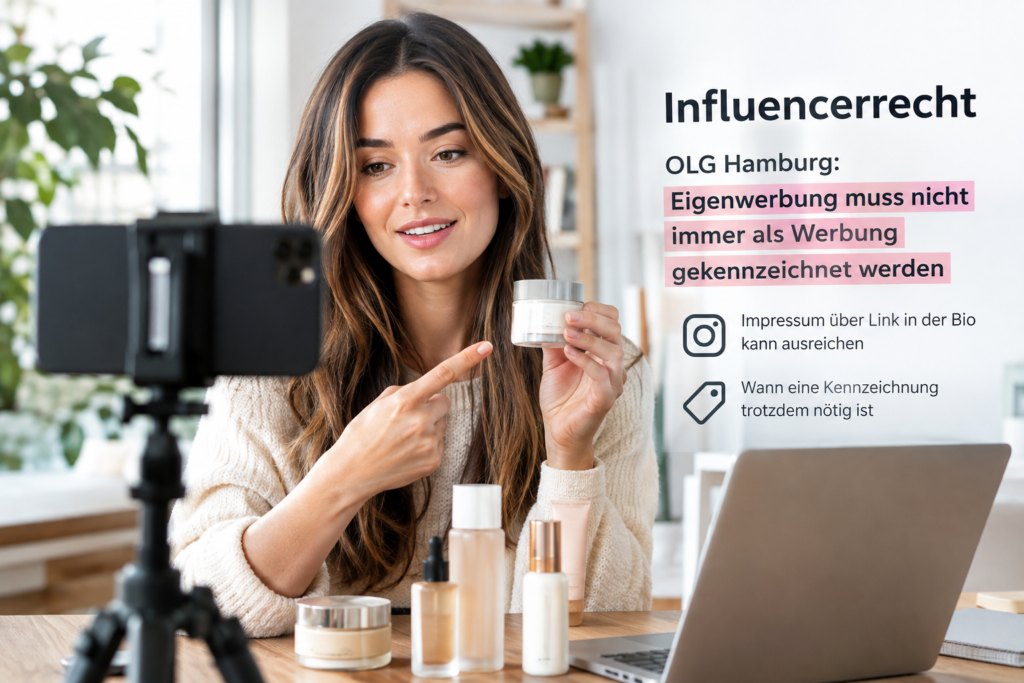
When does an Instagram post have to be marked as an advertisement? And is a link to the imprint in the Instagram bio enough? The Hanseatic Higher Regional Court of Hamburg, with its judgment of May 21, 2026 – 15 U 99/24 answers two questions that are particularly interesting for influencers and content creators.
The court ruled in favor of a well-known influencer: a Link to the imprint below the Instagram bio can meet the requirements of § 5 Para. 1 DDG. In addition, a post with which an influencer advertises products from his own company does not necessarily have to be marked with “advertising” or “advertisement” if the commercial purpose is already clearly recognizable to the average user.
The plaintiff’s appeal was completely rejected.
The case: Instagram, millions of followers and own brand
The focus was on the Instagram account of a very well-known influencer with around 9.3 million followers.
The account was operated by business. The influencer was also a founder and significantly involved in a company that offered hair care products under its own brand.
On her Instagram account, she published a post in which she presented her own products and, among other things, pointed out her “10 Products”.
The plaintiff saw this as a violation of the legal labeling obligations for commercial communication. He also objected to the design of the imprint of the Instagram account.
The Hamburg Regional Court had already rejected the claims. The Hamburg Higher Regional Court has now confirmed this decision.
Imprint on Instagram: A link can suffice
For influencers, the question of the imprint is particularly relevant to practice.
§ 5 para. 1 DDG obliges providers of business-like digital services to provide certain information – in particular the information required for the imprint – Easily recognizable and immediately accessible as well as available at all times.
However, this does not necessarily mean that all imprint information must be directly in the Instagram profile.
According to the Hamburg Higher Regional Court, it may be sufficient if There is a clearly visible link to a website below the bio, on which the full imprint can be accessed.
The decisive factor is that the average Instagram user can find the imprint without searching for a long time.
In this specific case, the link was placed directly below the bio and visually highlighted. That was enough for the court.
What does “immediately accessible” mean?
The court relied on the average Instagram user.
He can expect that an imprint for an Instagram account can be reached via a link in the bio. It is therefore not necessary to write the complete imprint data directly to the Instagram profile.
However, it remains important:
The link must actually work and lead to a complete imprint.
A mere link somewhere in the profile is not automatically enough.
A short-term technical fault does not yet make a missing imprint
Another aspect of the judgment is particularly interesting.
The plaintiff had asserted that when clicking on the imprint link, error messages were displayed on two specific days.
The Hamburg Higher Regional Court did not yet see this as a violation of Section 5 (1) DDG.
A Temporary Technical Disruption In the opinion of the court, accessibility does not automatically constitute a violation of the obligation to keep the imprint permanently available.
In particular, it must be clarified how long the disruption actually existed and whether it occurred in general or only under certain technical circumstances.
Particularly noteworthy: In this specific case, the disruption could even have been in the technical domain of the person who invoked them.
For influencers and companies, this does not mean that the technical availability of the imprint would be unimportant. On the contrary: an imprint link should be checked regularly.
Does self-promotion have to be marked as “advertising”?
The decision on the subject of advertising is even more interesting.
According to Section 5a (4) UWG, it can be unfair if the commercial purpose of a business activity is not identified and this purpose does not emerge directly from the circumstances.
So the crucial question is:
Does an influencer have to write “advertising” about a post when they advertise their own products?
The answer of the OLG Hamburg is: Not mandatory.
Because the commercial purpose does not have to be marked separately if it is already clearly recognizable to the average user.
Self-promotion is something other than hidden product placement
The court initially made it clear that the offending Instagram post was definitely one business action represented.
The influencer eventually advertised products from her own company.
However, that alone does not mean that “advertising” or “advertisement” must also be above the post.
The decisive is the Overall impact of the account and the specific post.
In the present case, the commercial character was obvious for several reasons.
Already in the bio, the influencer was described as the “founder” of the corresponding brand. The name of the brand itself also indicated its own company.
In addition, there were typical advertising statements and references to the products offered.
For the average Instagram user, therefore, the court did not have any serious doubts that the influencer wanted to sell her own products here.
9.3 million followers also play a role
A special feature of the case was the enormous reach of the influencer.
The Instagram account had around 9.3 million followers and was also marked by the blue verification hook.
The Hamburg Higher Regional Court took these circumstances into account when an average user understands the account and the specific post.
What is interesting is that the awareness of the influencer did not mean that particularly strict labeling obligations were accepted.
Rather, the design of the account in particular was able to help ensure that the commercial purpose immediately recognizable was.
The overall view is crucial
However, influencers should not draw the wrong conclusion from the judgment:
“Self-promotion must never be marked as advertising.”
That’s not what the Hamburg Higher Regional Court says.
Rather, the court demands a concrete consideration of the respective account and post.
For example, the assessment can play a role:
- Who runs the account?
- Which products are presented?
- Do these products belong to the influencer himself?
- How is your own brand presented in the bio?
- Is the influencer recognizable as a founder or entrepreneur?
- How is the specific post designed?
- What formulations are used?
- How obvious is the sales purpose?
- How does an average user understand the post?
So it’s not just a matter of what is advertised, but also like communication is designed.
What influencers should take away from the judgment
The judgment provides some practical guidelines.
1. Link imprint via the bio
An imprint does not necessarily have to be completely in the Instagram bio.
A Clearly visible and immediately accessible link A website with a full imprint can suffice.
2. Check the imprint link regularly
Even if a short-term technical fault does not automatically constitute a violation of the law, the link to the imprint should work reliably.
A broken link can quickly become an avoidable legal problem.
3. Present your own products transparently
Anyone who sells their own products should present the business background of their account as clearly as possible.
A clear indication such as “Founder” or a recognizable assignment to your own brand can help make the commercial purpose obvious to users.
4. Not every product attribution is the same
An influencer who advertises his own products is in a different situation than an influencer who presents a foreign company’s products for a fee or other advantages.
Straight at Paid cooperations with third parties the advertising label should be checked with particular care.
The judgment does not strengthen the “advertising without labeling”, but the transparency
The actual message of the OLG Hamburg is therefore somewhat more differentiated.
Competition law does not necessarily require that any commercial communication be provided with a large “advertising” notice.
If the commercial character clearly recognizable at first glance additional labeling may be dispensable.
This is particularly interesting for influencers with their own brands. Anyone who is clearly recognizable as an entrepreneur and advertises their own products to their followers does not necessarily have to pretend to be a neutral product recommendation.
It is precisely this distinction between covert advertising and obvious self-promotion is important for influencer practice.
Clarity for influencers
With its decision of May 21, 2026, the Hanseatic Higher Regional Court Hamburg creates more clarity for influencers on Instagram.
A Imprint can be made accessible via a clearly visible link in the bio. And in the case of an Instagram post that is clearly recognizable as self-advertising, an additional labeling may be dispensable as advertising.
For influencers, however, this does not mean a free ticket.
The concrete design is always decisive. If the commercial purpose is not clearly recognizable to the average user, labeling obligations may apply.
If you use Instagram professionally for your own company, for cooperation or for the sale of your own products, you should not only look at individual posts, but also entire appearance as commercial communication make legally clean.

Get to know our Germany-wide locations.
The decision at a glance
Hanseatic Higher Regional Court Hamburg, judgment of 21.05.2026 – 15 U 99/24
- Dish: Hanseatic Higher Regional Court Hamburg, 15th Civil Senate
- File number: 15 U 99/24
- Decision Date: 21.05.2026
- Value in dispute: 25,000 euros
- Imprint: Link from the Instagram bio may be sufficient
- Self-promotion: Additional advertising labeling may be dispensable if the commercial purpose is immediately recognizable
- Result: Appeal rejected
- Appeal: not allowed
- Important standards: § 5 DDG, § 5a UWG, § 6 DDG