
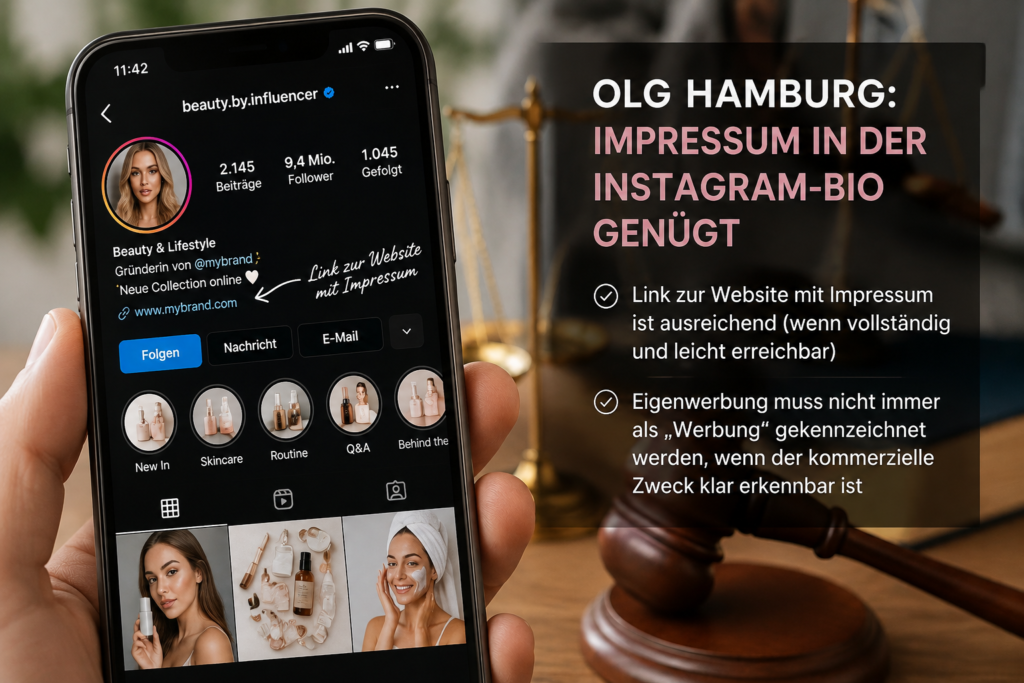
Do influencers have to mark every advertising Instagram post as an advertisement? Is a link in the bio sufficient for the imprint? With judgment of May 21, 2026 (Az. 15 U 99/24) the Hamburg Higher Regional Court has answered two important questions of influencer marketing. The decision strengthens the legal certainty for Creator, but at the same time makes it clear that the specific design of the account and the respective contribution is always important.

Whether there is an obligation to label depends on the specific circumstances of the respective contribution. There is no general exception for influencers. Just get in touch with us and let us advise you!
What was it about?
A competition association had sued a well-known influencer with several million followers on Instagram.
The focus was on two allegations:
- The imprint of your Instagram account is not properly accessible.
- A product post for your own cosmetics brand should have been expressly marked as advertising.
The Hamburg Regional Court had already dismissed the lawsuit. The Hamburg Higher Regional Court fully confirmed this decision.
Imprint via a link in the bio is enough
The statement of the court on the imprint obligation is particularly relevant to practice.
According to § 5 DDG, business-like online offers must have an easily recognizable and immediately accessible imprint.
The Hamburg Higher Regional Court clarifies:
A Link in the Instagram bio to your own website is generally sufficient if a complete imprint is available there.
According to the Senate, an average Instagram user expects the imprint to be reached via a website link if necessary.
The only thing that matters is that
- the link is clearly visible,
- the imprint remains available without long searching and
- the statutory mandatory information is fully available.
Short-term technical errors do not automatically lead to a violation
In the proceedings, the plaintiff also submitted that the link did not work for two days.
The court did not accept this objection either.
A only temporary technical fault does not justify a violation of the imprint obligation. Others can only apply if there is no permanently available imprint or the operator is responsible for the defect.
Does advertising for your own brand have to be marked?
The second part of the decision concerns advertising labeling.
The influencer had introduced her own line of cosmetics on Instagram.
A competition association said that the contribution should have been expressly marked with “advertising” or “advertisement”.
The Hamburg Higher Regional Court disagrees.
The commercial purpose was immediately recognizable
According to § 5a UWG, advertising must only be marked separately if the commercial purpose not already immediately apparent from the circumstances.
That is exactly what the court did not think was the case here.
Several circumstances immediately made the advertising character clear:
- The influencer was the founder of the advertised brand.
- Already in the Instagram bio, she was expressly referred to as a founder.
- The brand name appeared in the account and in the post several times.
- In the article, our own products were presented and offered for sale.
- Formulations such as “We are Live” or “Have a Look at My 10 Products” left no doubt about the intention to sell.
At first glance, every average user was aware that it was an advertisement for their own company.
Millions of followers also play a role
It is also noteworthy that the court expressly takes into account the awareness of the influencer.
The account had more than nine million followers and had the well-known blue verification mark.
This also makes it clear to users that it is a professionally operated company appearance.
According to the court, this also suggests that the commercial purpose was recognizable without separate labeling.
No general exemption from the advertising label
However, the decision in no way means that influencers will be allowed to do without advertising labels in the future.
Rather, the Higher Regional Court emphasizes that there is always a Overall view is required.
Among other things, the decisive factors are:
- the design of the entire account,
- the specific design of the contribution,
- the expectation of the average user,
- The question of whether your own or third-party products are advertised,
- and the immediate recognition of the commercial purpose.
Especially in the case of cooperation with third-party companies or less clearly designed contributions, labeling may still be mandatory.
What does the verdict mean for influencers?
For creators, there are several important information from the decision:
- A complete imprint can always be provided via a clearly visible link in the bio.
- Advertising for your own brand does not necessarily have to be marked with “advertising” if the advertising character is obvious to everyone.
- The specific individual case always remains decisive.
- The clearer a contribution appears to be self-promotion, the sooner an additional labeling can be dispensed with.
Recommendations for action for creator
If you want to stay on the safe side, you should still observe a few basic rules:
- Check the imprint regularly for availability.
- Place the link clearly in the bio.
- Transparently present your own brands and companies.
- Continue to carefully identify cooperations with third-party companies.
- If in doubt, it is better to mark once more than once too little.
A regular legal review of the social media presence is also recommended, especially for changing platform functions or international campaigns.
With its decision, the Hamburg Higher Regional Court creates more legal certainty for influencers and content creators.
An imprint does not necessarily have to be deposited directly within Instagram. A clearly visible link to your own website can suffice if a complete imprint is available there.
The court also confirms the line of the Federal Court of Justice when it comes to advertising labeling: If the commercial purpose of a contribution is already clearly recognizable due to its design, no additional labeling is required as advertising.
Nevertheless, caution is advised. Whether there is an obligation to label depends on the specific circumstances of the respective contribution. There is no general exception for influencers.